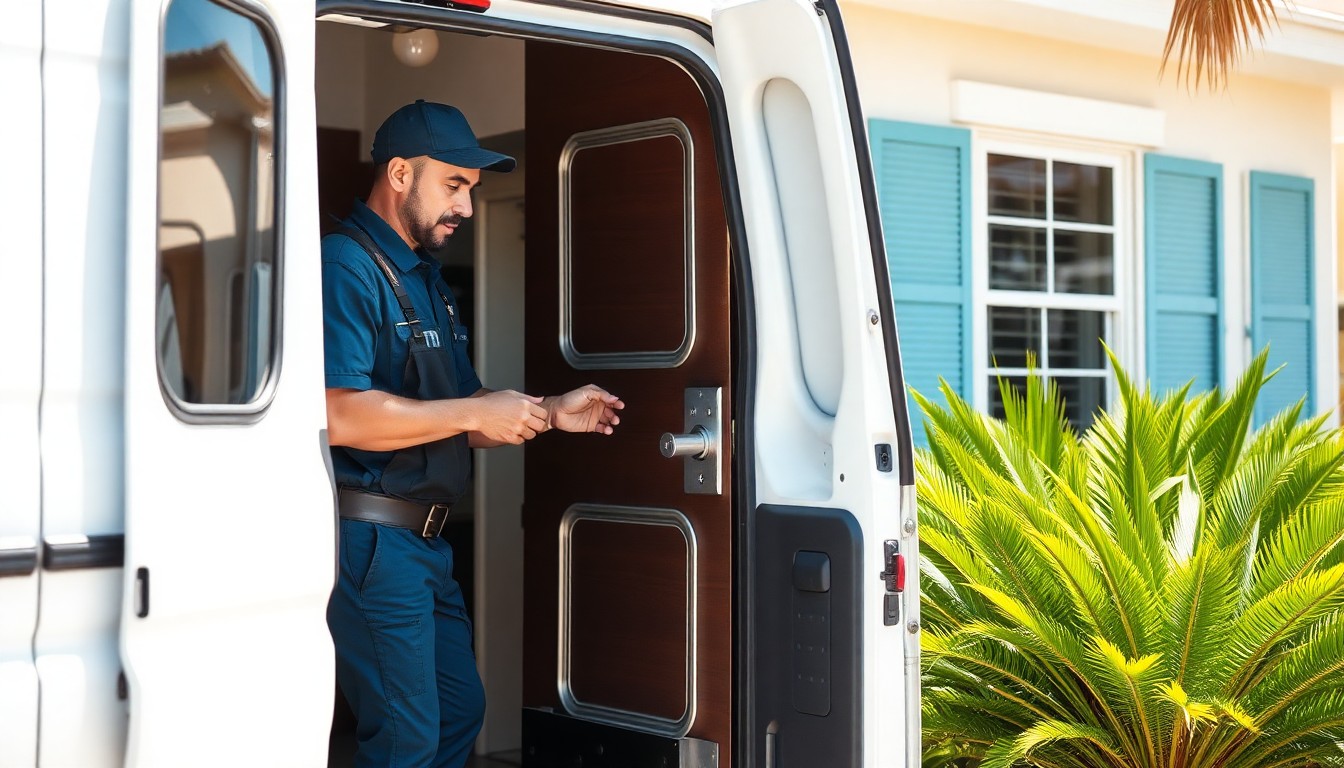
Service Across Miramar Beach and Sandestin
Our work is non-destructive whenever possible. We pick, bypass, and pin-set far more locks than we ever drill. Drilling a lock is a last resort that costs you a replacement lock plus the service — we'd rather take the extra five minutes and save your hardware.
What We Do
Emergency lockouts, lock rekeys, car key replacement and programming, residential security upgrades, commercial master key systems, and panic bar service — the full residential and commercial scope, with 24/7 emergency response. We also handle the security work the resort economy here demands: smart lock installation with auto-expiring rental codes, security camera systems built for Gulf-front salt air, and access control for condo common doors and storefronts. One local crew handles the locks, the cameras, and the keypads on a single quote.
Service Hubs
Jump straight to what you need: Lockout · Rekey · Car Keys · Residential · Commercial · 24-Hour Emergency · Key Fob · Smart Locks · Security Cameras · Access Control · Garage Doors
Neighborhoods We Cover
We dispatch across Miramar Beach and the Sandestin Golf & Beach Resort, from the Gulf-front towers on Scenic Gulf Drive to the gated golf communities inland. Tell us your area and we give you a real ETA:
Miramar Beach · Sandestin Resort · Baytowne Wharf · Scenic Gulf Drive / Hwy 98 · Silver Shells · Burnt Pine · Kelly Plantation · Frangista Beach · Holiday Isle · Seascape · Emerald Bay · Regatta Bay
See every community we serve, including the Grand Boulevard and Silver Sands corridors, on the full service-area map.
Why Miramar Beach Locksmith Pro
Most locksmith work in this country happens at one front door on one detached lot. Miramar Beach is not built that way. The majority of doors here belong to low-rise and mid-rise condominium buildings, townhome rows, and gated neighbourhoods — and when you are locked out of one, the unit door is rarely the only door in your way. There is usually a lobby or breezeway door, sometimes a vehicle gate, sometimes an elevator that will not move without a fob, and each of those layers is controlled by a different party than the one who owns the lock on your unit.
That layering is the job here. Before a truck leaves we work out which door is actually stopping you, because a lobby reader, a gate controller, an elevator fob and a unit deadbolt are four unrelated pieces of hardware with four different ways through.
Car Lockouts in Miramar Beach
Car lockouts are the call we take most often, and the setting makes them their own problem. Almost nobody here parks in a private driveway. It is a shared surface lot, a covered deck under a building, a beach access lot, or a resort service road — and the driver cannot simply walk back with a spare, because the spare is a hundred miles away at home.
The beach adds its own failure modes. Keys go into a beach bag and the bag goes into the trunk, which locks itself the moment the door closes. Push-to-start vehicles get walked away from with the fob still inside, and because there was never a metal key in the ignition, nothing warns the driver. Fobs get carried into the water in a pocket and stop transmitting once the salt dries across the board. Sliding minivan doors, tailgates and rear hatches latch on their own logic and often need a different approach from the front doors on the same vehicle.
Opening a locked vehicle without damaging it means reading the door and its linkage, not forcing anything. Wedges open a controlled gap, a long-reach tool works the interior handle or the lock stem, and side-curtain airbags and wiring looms inside the door cavity dictate where a tool can go.
When the car is behind a gate
If your vehicle sits behind a resident gate, inside a parking deck, or in a lot needing a decal or arm-gate credential, say so when you call. We can usually be met at the entrance, but that is a conversation with whoever staffs it, and it goes better before we arrive than while we sit at a keypad.
Car Key Replacement and Fob Programming
A lost car key on holiday is not a small inconvenience, because the dealer route usually means a tow and a wait measured in days. We cut and program replacement keys and fobs on site, including cases where every copy is gone and there is nothing left to duplicate from.
Three things drive the job. The key type — a blade key with a transponder chip, a flip key, a proximity fob for a push-to-start car, or a smart key paired to the vehicle's immobiliser. Proof the car is yours — we ask for the registration or title and a photo ID, every time, because that check is the only thing between a legitimate key service and helping somebody steal a car. And the vehicle's programming rules, which on some models require all existing keys present and on others wipe previously programmed keys when a new one is added.
Rentals are separate. A rental company's key is their property, and the agreement generally routes a lost key through the company rather than a locksmith. If you are holding a rental agreement, call them first — we will say the same on the phone.
Getting Into a Condo or Mid-Rise Unit
A unit lockout in a multi-storey building is a different job from a house lockout, and the difference is almost never the unit lock. It is access. If the building's common door is secured and you have no fob, a locksmith outside it is no closer to your door than you are. The answer is to reach whoever holds building access first — on-site staff, the manager on call, or the association's after-hours contact — and have them meet the tech.
At your door the entry itself is ordinary craft. Most unit doors carry a standard cylinder in a knob or lever plus a deadbolt, and both open non-destructively with picks or a bypass in the great majority of cases. What complicates things is an upgraded door — a high-security cylinder, an auxiliary lock added by a previous owner, or a keyed patio-side door that has seized. Tell us what you can see from the hallway and the right tools come up in one trip.
Who Is Actually Allowed to Authorise a Lock Change
This question stops more condo jobs than any lock does. A locksmith can only work on hardware for the person entitled to control it, and in a multi-unit building that entitlement is split.
The lock on your own unit door is generally yours as the owner to rekey or replace, subject to what your association's rules say about key uniformity and master-key access. A guest or short-term occupant is not the owner and cannot authorise a change to it. Common areas are a different animal: lobby doors, stairwell doors, mail kiosks, amenity rooms, pool gates and the vehicle gate belong to the association, and only someone with authority delegated by the board or its management company can order work on them. A single owner, however frustrated with a sticking gate latch, cannot.
So we ask who you are in relation to the door before starting. That is not bureaucracy for its own sake — it is what stops a lock change becoming somebody else's dispute.
Rekeying a Unit Door Between Owners and Between Occupants
Rekeying is the pin-and-key half of security, and it is the right answer far more often than replacing a lock. The cylinder stays on the door, the finish still matches, and the old keys stop working — which is the actual goal.
Two moments call for it. A change of ownership: a unit that has been through a sale has an unknown number of keys in circulation — previous owners, cleaners, contractors, a neighbour who watered plants. Nobody can reconstruct that list, so reset the pins and start the key history from zero. And any point where a key left your control and did not come back. We can also key several doors in a unit alike, so the unit door, a patio-side door and a storage closet take one blade instead of three.
Common-Area Doors, Amenity Rooms and Pool Gates
Shared hardware in a beach community takes a beating no residential lock will ever see. A pool gate latch cycles constantly through a summer day, gets pushed by wet hands, and sits in salt air with no shelter. An amenity room door propped open in the heat drags its closer out of adjustment and bends the strike alignment.
Most of what goes wrong is mechanical and fixable: a latch no longer reaching the strike because the closer lost tension, a self-closing hinge with a tired spring, a lever with worn internals, a cylinder full of grit. Replacing the whole assembly is often unnecessary. This work is scoped and authorised by the association or its management.
Elevator Fobs, Garage Fobs and Community Credentials
Fob-controlled elevator and garage access is standard in the taller buildings along the Miramar Beach coast, and it is where the security stack stops being locks and starts being electronics. A credential that is lost, dead or de-programmed looks identical from outside the door.
A credential enrolled in a building's own access system can generally only be issued or revoked by whoever administers that system — the association or its management company, not a locksmith who has never seen the panel. What we can do is diagnose the reader side, program credentials on systems we are engaged to maintain, and install or service access control hardware for owners and boards wanting a system of their own. Vehicle remotes are a different service, covered under key fob programming.
Community and Cluster Mailbox Locks
Cluster mailbox banks are the most-forgotten lock in a community and carry more risk than people assume, because that is where cards, cheques and documents land. The small wafer cylinder in a mailbox door is not built for where it sits: outdoors, unsheltered, in constant salt air, worked by a key that shares a ring with heavier keys levering it sideways.
Two failures dominate — a key that turns without opening, usually a worn or spun cam behind the cylinder, and a key that no longer enters cleanly because the cylinder has corroded. Both are ordinary cylinder replacements once the box is open. Individual compartments are the resident's or the association's to service; the outgoing-mail and carrier-access sections belong to the postal service and are not ours to touch.
Sliding Patio and Balcony Door Locks
The sliding glass door onto a balcony or patio is the most-ignored entry point in a beach condo, and often the weakest. The factory latch on most sliders is a small hook or spring clip catching a thin strike in the frame — a positioning device more than a security device, and the one thing standing between an accessible balcony and the outside.
Three improvements cover almost every slider we see. An auxiliary foot-bolt or pin lock dropping through the moving panel into the fixed frame stops it travelling regardless of the factory latch. A bar in the track prevents it sliding even if the latch is defeated. And an anti-lift adjustment — raising the head-track screws or fitting anti-lift blocks — removes the ability to bounce the panel out of its track, which is how sliders actually get opened.
The other slider problem is not security at all: the door no longer closes far enough to latch. That is nearly always rollers worn flat, a track packed with sand, or a frame that has shifted — a repair rather than a replacement, and worth doing before the day it will not lock at all.
Storage Closets, Beach Lockers and Board Rooms
Every beach building has secondary locks nobody thinks about until one fails: an owner storage closet on the parking level, a beach locker near the boardwalk, a bike and board room. They carry the cheapest padlock in the building, sit closest to open air and blown sand, and hold the things most likely to walk away. Swap an open-shackle padlock for a shrouded body in a corrosion-resistant material, which removes the bolt-cutter angle and the seizing problem at once. And where a resident juggles four keys for four closets, key them alike.
Golf Cart Keys
Golf carts are everyday transport in the Miramar Beach and Sandestin communities, not just course equipment, and they lose keys the way everything else here does. Most carts use a simple, widely shared key pattern rather than anything vehicle-grade — convenient when you have lost yours, sobering when you think about what it means for security. Newer carts use coded switches and fob ignitions and behave more like small vehicles. We cut replacement cart keys and service seized ignition switches.
Townhome Garage Entry Doors
Townhomes carry a door condominium units do not: the passage door between the garage and the living space. It is the most-used exterior-rated door in the home and the least-maintained, and often the weak point in an otherwise secure property, because once someone is inside the garage they can work on it unseen.
Three things are worth doing there. Fit a real deadbolt rather than relying on a knob or lever latch alone. Replace the short screws in the strike plate with long screws reaching the wall framing — the cheapest meaningful upgrade in residential security, and a job of minutes. And rekey it alongside the front door so it is not the one door still on an old key. If the opener, springs or tracks are the problem rather than the entry door, that is garage door service.
Why Locks Fail Faster on This Coast
Hardware in Miramar Beach lives a harder life than the same hardware three counties inland, and the maintenance answer is counter-intuitive. Salt-laden air settles on everything near the Gulf, and it needs no rain or spray to do damage — humidity alone keeps a salt film active on metal. It attacks the small springs and thin brass pins inside a cylinder long before anything shows on the outside, which is why a lock that looks fine turns badly. It also reaches the parts nobody inspects: hinge pins, latch springs, strike plates, and the screws holding all of it to the frame.
Dry lubricant, not oil
The instinct when a lock gets stiff is to spray oil into it. Do not. Oil and general-purpose penetrating sprays are sticky, and in air full of sand and salt crystals they turn the inside of a cylinder into grinding paste — the lock feels better for a week, then seizes worse than before. Use a dry lubricant: graphite, or a PTFE or similar dry-film spray that carries in on a solvent, flashes off, and leaves a slick deposit with nothing for grit to cling to. A cylinder already oiled and gone gritty needs cleaning out rather than more lubricant on top.
Storm-Season Door and Frame Preparation
Storm season here is a wind and water event first, and doors are where buildings leak and fail. Start at the frame rather than the lock. A deadbolt is only as strong as what it throws into, so the strike plate should be a reinforced one anchored with screws long enough to bite structural framing, not trim. Check the bolt fully extends — a door that has shifted so the bolt throws halfway offers a fraction of the resistance it should. On outward-opening doors, confirm hinge screws are tight and pins are not corroded through.
Afterwards matters too. Wind-driven water sits in cylinders, so exterior locks are worth drying and treating with a dry lubricant once weather passes. If a door will not latch after a storm, that is an alignment job — forcing it repeatedly is how it becomes a replacement instead of an adjustment.
Broken Keys and Keys That Turn But Do Not Open
A key that snaps in a lock almost never snaps without warning. It has usually been getting harder to turn for weeks — corrosion inside the cylinder, a worn key, a misaligned door putting the bolt under load — and the break is the last event, not the first. That matters, because extracting the broken half is only half the repair: if the cylinder is corroded or the door is out of alignment, a fresh key in the same lock will break too. The other version of this call is a key that turns freely and does nothing, which means the connection between cylinder and bolt has failed — a stripped cam, a broken tailpiece, or a seized mechanism.
What to Have Ready When You Call
Four things change what goes on the truck. What is locked — a unit door, a house, a vehicle, a mailbox, a storage closet, a gate. Where it is, precisely enough to route to: a building and floor beats a street name, and for a vehicle, which lot and roughly where in it. Whether anything sits between us and the door — a gated entrance, a secured lobby, a fob-controlled elevator — and who can let us through. And your relationship to the door. For a car key, add the make, model and year, and whether it is push-to-start. We give an all-in quote on the phone before anyone is dispatched.